
Exosomes vs Stem Cells vs PRP: A Provider Comparison

The fast facts

On this page

What Are Exosomes? A Clinician’s Guide to Extracellular Vesicles in Regenerative Medicine
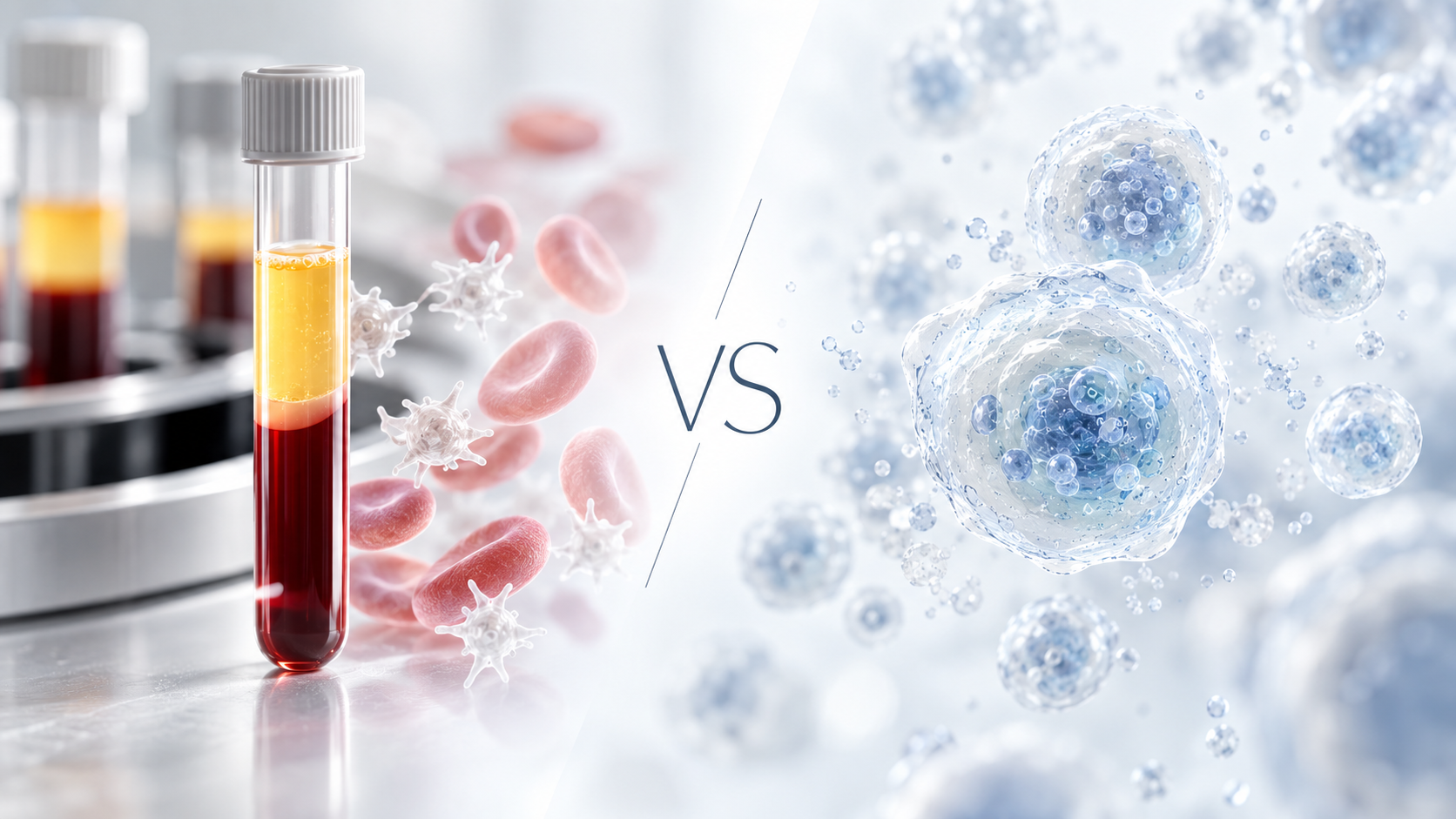
Three options, three different categories, and a lot of content that blurs them together. When a provider is deciding what to add to a regenerative menu, the comparison that actually helps isn’t “which one works best”; that’s an outcome question the evidence base is still developing, and no honest article can settle it in a table. The comparison that helps is structural: what each of these things is, how it’s sourced, how it behaves in your fridge, and what you have to verify before you stock it. [1,4] 
This is that comparison, written for the clinic owner or purchasing lead building a catalog. It’s descriptive throughout and makes no claims about clinical outcomes. It’s a framework for comparing three product categories on the terms a provider can actually control.

The three categories, defined

The first source of confusion is that these three aren’t points on a single spectrum; they’re different kinds of things.
  • Exosomes are extracellular vesicles (roughly 30–150 nm) isolated from cultured cells. They’re a manufactured, allogeneic (donor-sourced) product that arrives ready to stock. CellGenic’s explainer on how exosomes work covers the biology. [1] 
  • Stem cells (in this context, cultured cell products such as MSCs) are living-cell products, also typically allogeneic when supplied as a stocked product. They’re a distinct category with distinct handling and regulatory considerations. [2,3,5] 
  • PRP (platelet-rich plasma) is autologously prepared from the patient’s own blood at the point of care, usually via a centrifuge and a processing kit, rather than purchased as a finished biological product.
That last distinction is the big one: PRP is a process you run in-house, while exosomes and stem-cell products are materials you source and stock. It changes everything about how you evaluate them.

Side-by-side: what a provider actually compares

Dimension Exosomes Stem cell products
(e.g., MSC)
PRP
What it is Extracellular vesicles
from cultured cells
Living-cell product Concentrated platelets
from the patient's own blood
Source Allogeneic
(donor-derived),
manufactured
Typically allogeneic,
manufactured
Autologous
(patient-derived),
prepared on site
How you obtain it Sourced & stocked Sourced & stocked Produced in-clinic with
a kit + centrifuge
Format Lyophilized or liquid Cryopreserved /
prepared
Prepared fresh per
patient
Cold chain Temperature-sensitive;
logger recommended
Strict cold-chain /
cryo handling
Minimal, used fresh
Key thing to verify COA, sourcing,
purity, cold chain
COA, viability,
sourcing, regulatory
status
Kit quality, centrifuge,
protocol consistency
Documentation
you should get
Batch-specific COA Batch COA + viability
data
Kit/consumable specs
& lot info

The table is the fastest answer. The paragraphs below explain why each row matters.

Sourcing: the dividing line

For exosomes and stem-cell products, sourcing is the whole ballgame, because you’re stocking a biological you didn’t make. The questions are the same for both: where did the source material come from, how was it processed, and can the supplier document the specific batch? A supplier who can answer clearly with a batch COA is a different proposition from one who can only describe the finished product.[1]
PRP flips this. You’re not sourcing a finished biological; you’re sourcing the equipment and consumables to produce it consistently: the kit and the centrifuge. The verification shifts from “prove this batch” to “will this process give me a repeatable preparation every time.” CellGenic’s autologous product kits sit in this category, while exosomes [6] and cellular products sit in the sourced-and-stocked one.

Handling and cold chain: where product quietly dies

Handling separates the three sharply. PRP is prepared fresh and used quickly, so cold-chain risk is minimal. Exosomes and stem-cell products are the opposite; both are temperature-sensitive, and a single cold-chain excursion can compromise material you’ve already paid for. [1,5]
Between the two sourced products, the handling burden differs: living-cell products carry strict cryopreservation and viability considerations, while exosomes are sensitive but often more forgiving in lyophilized form. For a practice weighing operational simplicity, this row often matters more than any headline about the product itself. The related distinction between exosomes and other cell products is covered in this descriptive comparison.

Documentation: the one requirement that doesn't change

Whatever you stock, the documentation requirement is constant: you should be able to account for what you’re using. For exosomes and stem-cell products, that means a batch-specific COA measured identity, purity, sterility, and (for cells) viability, tied to the lot. For PRP, it means clean lot information on the kit and consumables, plus a consistent in-house protocol.
This is the requirement that protects the practice regardless of which category you choose. A supplier who ships proof by default, as CellGenic does with a COA in every box, tested per batch across five assays, makes this requirement easy to meet rather than a thing you have to enforce.

So which fits your practice?

The honest verdict is that these aren’t competitors so much as different tools with different operational profiles, and many practices carry more than one. The decision usually comes down to your setup and appetite for handling complexity:
  • If you want a sourced, stockable product and can manage the cold chain, exosomes are the most operationally straightforward of the sourced options.
  • If you’re prepared for cryo handling and viability management, stem-cell products are a distinct category worth evaluating on their own terms.
  • If you’d rather produce fresh on-site and control the process end-to-end, PRP shifts the decision to equipment and protocol. [6] 
For a fuller treatment of exosomes, specifically the category most providers add first, see the descriptive explainer on the difference between exosomes and other cell products.

The comparison, distilled

Exosomes, stem cells, and PRP aren’t three answers to one question; they’re three categories with different sourcing, handling, and verification demands, and the right choice is the one that matches how your practice actually operates. What doesn’t change across any of them is the need to account for what you stock.

If exosomes are the category you’re leaning toward and cost is your next question, CellGenic’s breakdown of exosome product cost is the natural next step or verify your provider credentials to see provider pricing and batch documentation directly. [2,3] 

This content is provided for professional, educational purposes for verified providers and does not constitute medical advice. It does not diagnose, treat, cure, or prevent any disease, and makes no claims about clinical outcomes or comparative efficacy. Regenerative products described here have not been evaluated or approved by the FDA for the uses discussed. Providers are responsible for compliance with the laws and regulations of their jurisdiction. (Confirm final disclaimer wording with counsel before publication.)

Frequently Asked Questions

Exosomes are cell-derived vesicles you source and stock; stem-cell products are living-cell products you source and stock; PRP is prepared from the patient's own blood on site. The biggest divide is sourced-and-stocked vs. produced-in-clinic. [1,5,6]
They aren't ranked competitors; they're different categories with different operational profiles. The evidence base for outcomes is still developing, so the practical comparison is on sourcing, handling, and documentation.
PRP is autologous, made from the patient's own blood, typically prepared at the point of care with a kit and centrifuge.
PRP has minimal cold-chain burden since it's used fresh. Among sourced products, lyophilized exosomes are often more forgiving than cryopreserved cell products.
A batch-specific COA for exosomes and stem-cell products; clean lot information on kits and consumables, plus a consistent protocol, for PRP.
Both are temperature-sensitive, and a single excursion can compromise the material. A temperature logger and validated shipping are the baseline for stocked biologicals.
Yes, many do, since they serve different operational needs. They're better thought of as complementary tools than as mutually exclusive choices.
Sourcing, batch-specific COA, measured purity, and cold-chain handling. A supplier that manufactures in-house and ships documentation by default makes this easier to confirm.
Kit quality, centrifuge performance, lot documentation on consumables, and whether the process gives a repeatable preparation.
See CellGenic's exosome product cost guide for a detailed pricing breakdown, then verify provider credentials for specific provider pricing.

References

  • Théry C, Witwer KW, Aikawa E, et al. Minimal information for studies of extracellular vesicles 2023: MISEV2023. Journal of Extracellular Vesicles. 2023. Available from: MISEV2023 overviewacademic.oup
  • U.S. Food and Drug Administration. Public Safety Alert Due to Marketing of Unapproved Stem Cell and Exosome Products. Available from: FDA Safety Alertfda
  • U.S. Food and Drug Administration. Human cells, tissues, and cellular and tissue-based products: regulatory information. Use the applicable FDA HCT/P and cellular-product guidance for the specific product category.
  • Indian Association of Dermatologists, Venereologists and Leprologists. Preparation of Platelet-Rich Plasma: National IADVL PRP recommendations. Available from: PubMed recordpubmed.ncbi.nlm.nih


Read next

Shopping cart0
There are no products in the cart!
Continue shopping
Cart Gated

Cart is provider-gated. Log in to view.

Provider Login →