 Medically Reviewed By
— Written By
— Updated on September 16, 2026
Medically Reviewed By
— Written By
— Updated on September 16, 2026
On this page
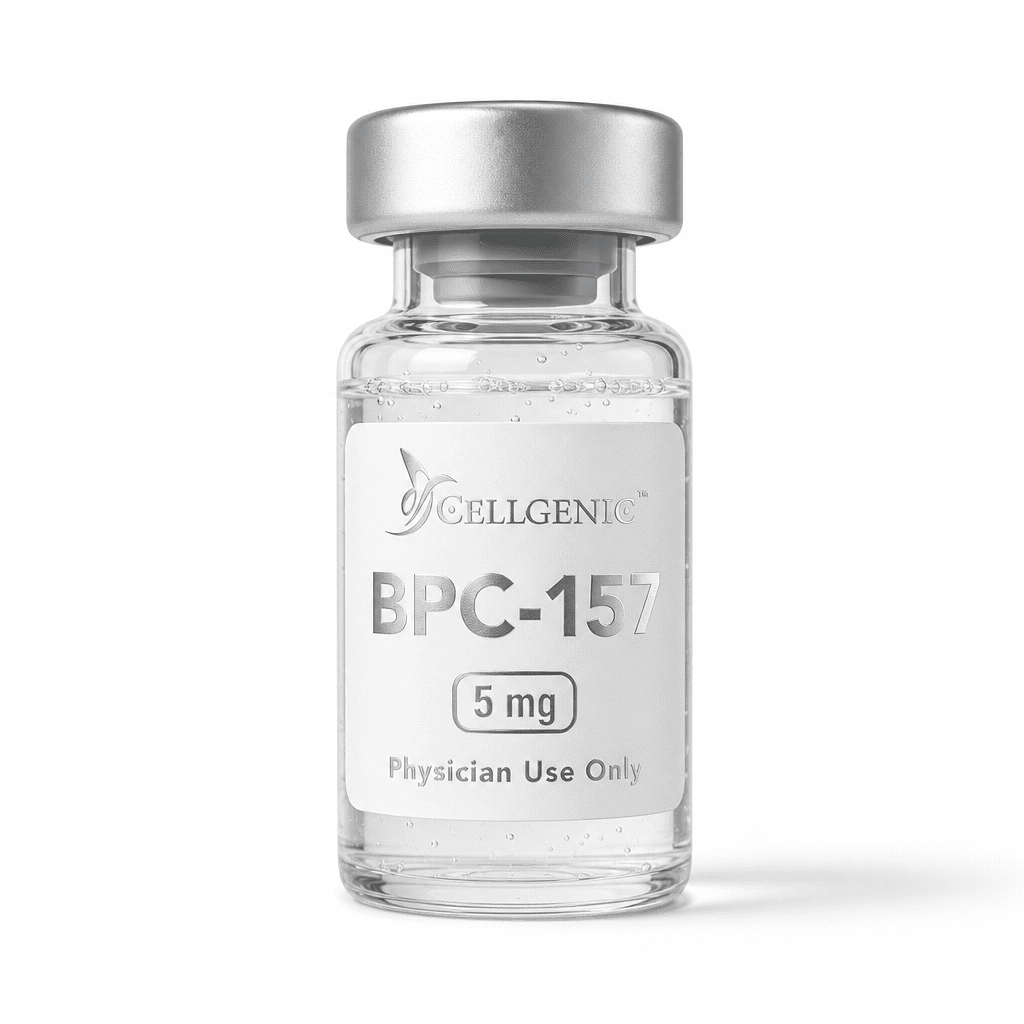
BPC-157 is a synthetic pentadecapeptide composed of 15 amino acids, originally identified from a protective protein sequence in human gastric juice. Published research has characterized BPC-157 as a cytoprotective agent with activity spanning gastrointestinal, musculoskeletal, and connective tissue models in preclinical studies (1). CellGenic’s BPC-157 is available in 5 mg, 10 mg, and 50 mg lyophilized vials manufactured to ≥98% purity under cGMP conditions.
Published literature on this body protection compound spans nitric oxide signaling, growth factor receptor interactions, angiogenic pathways, and tissue repair models across gastrointestinal, tendon, muscle, and bone systems (1). Researchers have identified multiple signaling mechanisms that may account for the range of tissue effects observed in preclinical models (3).
This article examines the current state of BPC-157 research, covering its molecular mechanisms, key findings from published studies, comparisons with related research peptides, and practical laboratory considerations.
Key Takeaways
- Published research has characterized BPC-157 as a synthetic pentadecapeptide (GEPPPGKPADDAGLV) derived from a protein sequence in human gastric juice, with the unusual property of stability in gastric acid (1).
- Published preclinical studies have demonstrated cytoprotective activity across gastrointestinal, tendon, muscle, ligament, bone, and neurological tissue models (1).
- A study in Molecules reported that BPC-157 upregulated growth hormone receptor expression in tendon fibroblasts and enhanced cell proliferation when combined with growth hormone (2).
- CellGenic’s BPC-157 dosage calculator supports accurate reconstitution calculations for research protocols.
What Is BPC-157?
BPC-157 (Body Protection Compound-157) is a synthetic pentadecapeptide, meaning it consists of 15 amino acids arranged in the sequence GEPPPGKPADDAGLV. Published research has described the compound as a partial sequence of a larger protein identified in human gastric juice (1). The designation “body protection compound” reflects the cytoprotective properties observed across multiple tissue types in preclinical models.
A defining characteristic of BPC-157, as documented in published studies, is its stability in human gastric juice (1). Most bioactive peptides are rapidly degraded by gastric acid and proteolytic enzymes, but researchers have found that BPC-157 resists this degradation. This acid stability has enabled investigators to study both parenteral and oral routes of administration in preclinical models.
How BPC-157 Works: Nitric Oxide and Growth Factor Pathways
Nitric Oxide System Modulation
A 2025 review published in Pharmaceuticals described BPC-157’s interaction with the nitric oxide (NO) system as bidirectional, maintaining, promoting, or recovering the essential protective functions of NO signaling rather than simply increasing or decreasing NO production (3).
Published data indicate that this modulatory activity allows the compound to support vasodilation and blood flow where healing requires it, while counteracting NO-mediated tissue damage in inflammatory contexts (3).
Growth Hormone Receptor Upregulation
A study by Chang et al. published in Molecules demonstrated that BPC-157 dose- and time-dependently increased growth hormone receptor (GHR) expression in tendon fibroblasts at both the mRNA and protein levels (2). When growth hormone was added to BPC-157-treated fibroblasts, the researchers observed that cell proliferation increased significantly, and Janus kinase 2 was activated time-dependently (2).
Angiogenesis via VEGFR2
BPC-157 Research in Gastrointestinal Tissue
The gastrointestinal system is the most extensively studied tissue domain for BPC-157 in published literature, consistent with the peptide’s gastric juice origin. Preclinical models have included NSAID-induced gastric mucosal damage, alcohol-induced gastric injury, restraint stress-induced lesions, inflammatory bowel disease models, and intestinal barrier permeability studies in rodent systems (1).
A review in Current Neuropharmacology described BPC-157’s interactions along the brain-gut axis, documenting effects on dopaminergic, serotonergic, and GABAergic systems in preclinical models (4).
BPC-157 and Connective Tissue Research
Tendon Healing
Chang et al. (2011) used a rat Achilles tendon transection model to demonstrate that BPC-157 accelerated tendon-explant outgrowth, increased tendon fibroblast migration in a dose-dependent manner, and improved cell survival under oxidative stress conditions (5). The researchers reported that the migration effect was mediated through activation of the focal adhesion kinase (FAK) and paxillin signaling cascade (5).
Muscle and Myotendinous Junction Research
Bone and Ligament Models
BPC-157 in Combination Research
Published data indicate that BPC-157’s nitric oxide-mediated mechanism is mechanistically distinct from other tissue repair peptides (3), making it a frequent component of multi-peptide research protocols.
CellGenic offers BPC-157 in several combination formats: the BPC-157 + TB-500 blend pairs nitric oxide modulation with TB-500’s actin-regulation mechanism. The KLOW Stack adds GHK-Cu (matrix remodeling) and KPV (NF-κB inhibition) for four-pathway combinatorial research.
Additional protocol bundles featuring BPC-157 include the Acute Musculoskeletal Injury bundle and the Chronic Inflammatory Pain & Degeneration Reset bundle. CellGenic’s peptide calculator automates concentration calculations for any vial size and target volume.
Reconstitution and Storage
What BPC-157 Research Reveals About Cytoprotection
Based on the published literature reviewed above, BPC-157’s position in regenerative medicine research rests on multiple characterized mechanisms: nitric oxide system modulation (3), growth factor receptor signaling (2), and angiogenesis across gastrointestinal and musculoskeletal models (1).
The breadth of published preclinical literature reflects the fundamental nature of the cytoprotective mechanisms researchers have identified in this body protection compound.
Frequently Asked Questions
BPC-157 stands for Body Protection Compound-157. Published research has described it as a synthetic pentadecapeptide composed of 15 amino acids, originally identified from a protective protein sequence found in human gastric juice (1). Researchers have characterized the compound by its unusual stability in gastric acid.
Published research has described BPC-157’s interaction with the nitric oxide system as bidirectional (3). Rather than simply increasing or decreasing NO production, studies indicate that the compound modulates NO activity contextually, supporting vasodilation and blood flow where healing requires it while counteracting NO-mediated tissue damage in inflammatory contexts (3).
Published preclinical studies have examined BPC-157 across gastrointestinal tissue (NSAID-induced injury, alcohol-induced damage, inflammatory bowel models) (1), tendon and connective tissue (5)(2), muscle and bone models (1), and neurological tissue through brain-gut axis interactions (4)
Researchers frequently investigate BPC-157 in multi-peptide protocols due to its distinct mechanism. Published data indicate that BPC-157 acts primarily through nitric oxide modulation (3), while peptides such as TB-500 have been studied for actin regulation and KPV for NF-κB inhibition. CellGenic offers both individual vials and pre-formulated combination products for multi-pathway research.
CellGenic offers BPC-157 individually and in several combination formats: the BPC-157 + TB-500 blend pairs two distinct tissue repair mechanisms, the GLOW Stack combines BPC-157 with GHK-Cu and TB-500, and the KLOW Stack adds KPV for four-pathway research. Multiple clinical protocol bundles also feature BPC-157.
References
- Sikiric P, et al. “The stable gastric pentadecapeptide BPC 157 pleiotropic beneficial activity and its possible relations with neurotransmitter activity.” Pharmaceuticals. 2024;17(4):461. MDPI Full Text
- Chang CH, Tsai WC, Hsu YH, Pang JH. “Pentadecapeptide BPC 157 enhances the growth hormone receptor expression in tendon fibroblasts.” Molecules. 2014;19(11):19066–19077. PMC Full Text
- Sikiric P, et al. “Stable gastric pentadecapeptide BPC 157 as a therapy and safety key: a special beneficial pleiotropic effect controlling and modulating angiogenesis and the NO-system.” Pharmaceuticals. 2025;18(6):928. MDPI Full Text
- Sikiric P, et al. “Brain-gut axis and pentadecapeptide BPC 157: theoretical and practical implications.” Current Neuropharmacology. 2016;14(8):857–865. PMC Full Text
- Chang CH, Tsai WC, Lin MS, Hsu YH, Pang JHS. “The promoting effect of Penta decapeptide BPC 157 on tendon healing involves tendon outgrowth, cell survival, and cell migration.” Journal of Applied Physiology. 2011;110(3):774–780. Full Text