
 Medically Reviewed By
— Written By
— Updated on September 16, 2026
The fast facts
On this page

Topical Application and Injected Use Are Different Questions

Why the Post-Procedure Window Changes What “Topical” Means
Microneedling disrupts the stratum corneum across a treated area and leaves behind a field of microchannels. Those channels don’t stay open indefinitely. A human-subjects study measuring skin barrier recovery after microneedle insertion found resealing times ranging from about two hours when the treated area was left uncovered to as long as 40 hours under occlusion, with the exact window depending on needle length, number, and array size (Gupta et al., Journal of Controlled Release, 2011). Technique and device vary the specifics, but the pattern holds: for a period measured in hours, the skin’s normal barrier function isn’t in place.[1].
Timing matters too. Whether a product is applied post-procedure immediately or after some interval is a handling variable worth documenting in your own protocol, alongside device settings and needle depth. What’s being evaluated at that stage is exposure and formulation fit, not outcome.
What “Sterile” Should Actually Mean on What You’re Applying
This is also where the field’s own quality expectations have been moving. The International Society for Extracellular Vesicles’ position statement on minimum reporting standards argues that claims about an extracellular vesicle preparation, including exosome products, need to be backed by specific, preparation-level documentation rather than general characterization of the source material (Théry et al., Journal of Extracellular Vesicles, 2018). A batch-specific COA is the practical, chairside version of that same standard. [3].

Vehicle and Viscosity: Matching the Product to the Application
- What is the vehicle composed of, and was it formulated with barrier-compromised skin in mind?
- Buffered isotonic saline and a gel-based carrier behave very differently on a microneedled field, and the answer changes both spread and residence time.
- Is the formulation preservative-free, or does it carry a preservative system built for a different route?
- A preservative profile appropriate for a sealed, multi-use vial isn’t automatically appropriate for direct contact with open microchannels.
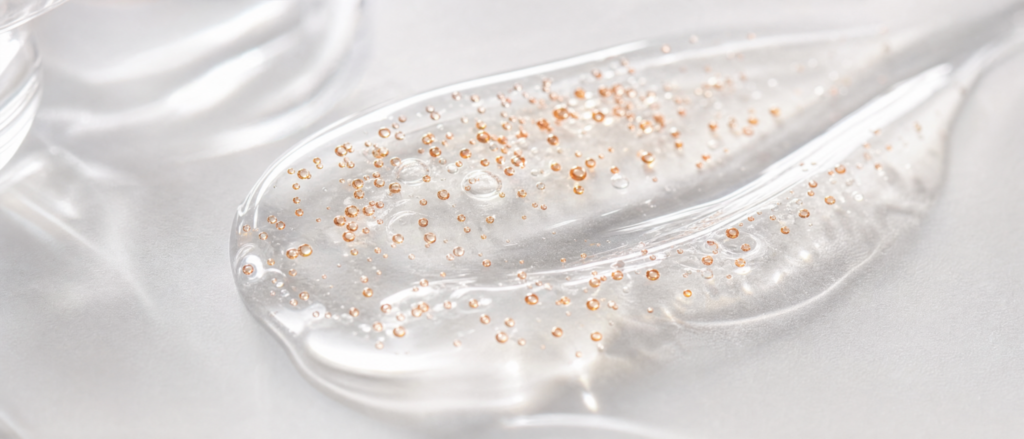
- What is the viscosity range, and does it support even distribution across the treated area without pooling or immediate runoff?
- Too thin and the product doesn’t stay where it’s applied. Too viscous and it doesn’t reach the channel field evenly.
- If the product is supplied lyophilized, what does the manufacturer specify for reconstitution?
- Diluent type, volume, and handling all affect exosome integrity before this stage even starts. Our [guide to lyophilized exosome storage and reconstitution](URL-TBD: lyophilized-storage-guide) covers the variables that matter most before a vial ever reaches the tray.
These aren’t cosmetic details. They determine whether a product that tests well on paper behaves appropriately in the fifteen minutes it’s actually in contact with disrupted skin.
What to Check on a Vial Before You Apply It
- Confirm the batch number against its Certificate of Analysis. The batch number, not the SKU, ties a specific vial to its specific test results. Locate the COA for that exact batch before proceeding.
- Inspect the vial before opening. Check for intact seals, absence of visible particulate, and, for a lyophilized product, a cake that hasn’t collapsed or discolored, which can indicate a cold-chain excursion.
- Verify the storage and cold-chain history. Confirm the product has stayed within its specified temperature range from receipt through point of use, and that documentation of that chain exists on file rather than being assumed.
- Cross-check the testing panel on the COA. Confirm mycoplasma, sterility, identity, and potency results are present for this specific batch, with values inside the manufacturer’s stated release specification, not just a pass or fail summary.
- Confirm the expiration or retest date. A product past its stated dating shouldn’t be used regardless of how it looks on visual inspection.
- Confirm the labeled intended use matches the application. Verify the documentation states topical use is within the product’s intended-use specification, and that this matches what’s about to happen at the tray, not a related product in the same supplier’s catalog.
- Document the check. Record the batch number, COA reference, and verification date in the patient or procedure record before use, consistent with standard chain-of-custody documentation for any research-use material.
This checklist happens before any clinical decision-making about the procedure itself. It’s a handling standard, applied the same way regardless of the patient or the day.

Building This Into a Sourcing Decision
If you’re weighing an exosome-derived product against PRP or a cell-based approach for a given protocol, our [comparison of exosomes, PRP, and mesenchymal stem cell products](URL-TBD: exosomes-vs-prp-comparison) covers how the three differ structurally and in handling, useful context ahead of a sourcing decision. For a closer look at what a COA should actually contain before you rely on it, see our [guide to reading an exosome Certificate of Analysis](URL-TBD: coa-reading-guide). And for the rest of CellGenic’s topical-use exosome products beyond this specific application, our [skincare pillar page](URL-TBD: skincare-pillar-page) lays out the current catalog.
Providers evaluating CellGenic as a source for research-use exosome products, including for post-procedure protocols, can apply for provider access to review current documentation, batch-specific COAs, and product specifications directly.
Common questions
No. Application route is one of the variables that determines how a product is classified, tested, and labeled in the first place, and a topical-use product’s documentation should reflect that directly rather than borrowing from an injectable product’s specification. Confirm labeled intended use against your actual application rather than assuming it from the product category alone.
At minimum, batch-specific mycoplasma, sterility, identity, and potency results, tied to the exact lot number on the vial in hand, not a product-line average or a general manufacturing claim. [2][3]
The reconstitution variables, diluent, volume, technique — affect exosome integrity regardless of intended application. But the resulting vehicle and viscosity need to be evaluated specifically against what topical, post-microneedling use requires, which can differ from what’s appropriate for other routes.
Ask for the COA tied to the batch number on your vial, not a representative or template COA. If a supplier can’t produce lot-specific results on request, that’s a meaningful gap regardless of what the general product literature claims.
Not without separate documentation and labeling covering each intended use. A preparation’s suitability for one application route doesn’t establish suitability for another, even when the underlying material comes from the same manufacturing process.
Whether the product is labeled and documented for topical application specifically, with batch-level testing to support it. Not whether exosome-derived products in general are suitable for post-procedure use.
References
- Gupta J, Gill HS, Andrews SN, Prausnitz MR. Kinetics of Skin Resealing After Insertion of Microneedles in Human Subjects. Journal of Controlled Release. 2011;154(2):148–155. doi:10.1016/j.jconrel.2011.05.021. PubMed/PMCpmc.ncbi.nlm.nih
- Théry C, Witwer KW, Aikawa E, et al. Minimal Information for Studies of Extracellular Vesicles 2018 (MISEV2018): Position Statement of the International Society for Extracellular Vesicles and Update of MISEV2014. Journal of Extracellular Vesicles. 2018;7(1):1535750. doi:10.1080/20013078.2018.1535750. PMCpmc.ncbi.nlm.nih
- International Society for Extracellular Vesicles. MISEV2018 Checklist. Available at: ISEV MISEV2018 Checklist.isev
- U.S. Food and Drug Administration. Public Safety Notification on Exosome Products. June 12, 2019. Available at: FDA
REGULATORY DISCLAIMER · CELLS
These products are intended for laboratory research use only. They are not drugs, foods, cosmetics, or medical treatments and must not be used for any form of human or animal administration. All information provided is for educational and scientific reference only and the products should be handled exclusively by licensed, qualified professionals. Misbranding, misuse, or mislabeling of these products as therapeutic or consumable substances is strictly prohibited by law.