 Medically Reviewed By
— Written By
— Updated on September 16, 2026
On this page

Five terms, one crowded supplier vocabulary, and an increasingly thin line between them in sourcing conversations. “Exosome,” “growth factor,” “secretome,” “PDRN,” and “peptide” show up constantly in the same paragraph, sometimes in the same sentence, as though they named one underlying material five different ways. They don’t. Each term refers to a structurally distinct category, with its own derivation, composition, and handling profile, and conflating them makes a sourcing decision harder to evaluate, not easier.
This isn’t a benefits comparison, and it isn’t a ranking. It’s a category map: what each term actually refers to, where the material originates, and how it’s structured relative to the other four. CellGenic sources across several of these categories, which is exactly why a neutral definitional pass is useful here rather than a pitch for any one of them.
In short: exosomes are cell-free lipid vesicles carrying a mixed cargo of signaling molecules. Growth factors are individual signaling proteins. The secretome is the complete profile a cell releases into its environment, of which exosomes are only one component. PDRN is a nucleotide-based compound derived from purified DNA. Peptides are short amino-acid chains, structurally unrelated to any of the other four. None of these five terms is a synonym for another, and none should be used interchangeably in a sourcing conversation.
The Category Table
| Category | What It Is | Derived From | Composition | Regulatory Note |
|---|---|---|---|---|
| Exosomes | Cell-free, nanoscale vesicles released by cells into their surrounding environment | Isolated from cultured cell material, most commonly mesenchymal-stem-cell-conditioned media | Lipid-bilayer membrane enclosing a mixed cargo of proteins, lipids, and nucleic acids | Classification varies by jurisdiction and intended use; CellGenic supplies exosome products for research use only |
| Growth Factors | Individual signaling proteins that bind specific cell-surface receptors | Produced recombinantly, or isolated from a biological source such as platelet concentrate | A single protein species, not a vesicle and not a mixed cargo | Status depends on formulation and derivation method; supplied by CellGenic for research use only |
| Secretome | The complete set of molecules a cell secretes into its environment | Collected as conditioned media from cultured cells | An umbrella term spanning multiple molecule classes at once, including both the vesicle fraction and the soluble, vesicle-free fraction | Not a single defined compound; classification follows whichever specific fraction is isolated |
| PDRN | A nucleotide-based compound composed of DNA fragments | Purified, fractionated DNA from salmonid (salmon or trout) gonadal tissue | A polymer of deoxyribonucleotides: genetic material, not a protein or a vesicle | Recognized as a registered pharmaceutical agent in certain jurisdictions; supplied by CellGenic for research use only |
| Peptides | Short chains of amino acids | Chemically synthesized to research-grade specification | An amino-acid chain, distinct in length and structure from a full protein | For research use only |
Exosomes: Cell-Free Vesicles, Not a Whole-Cell Product
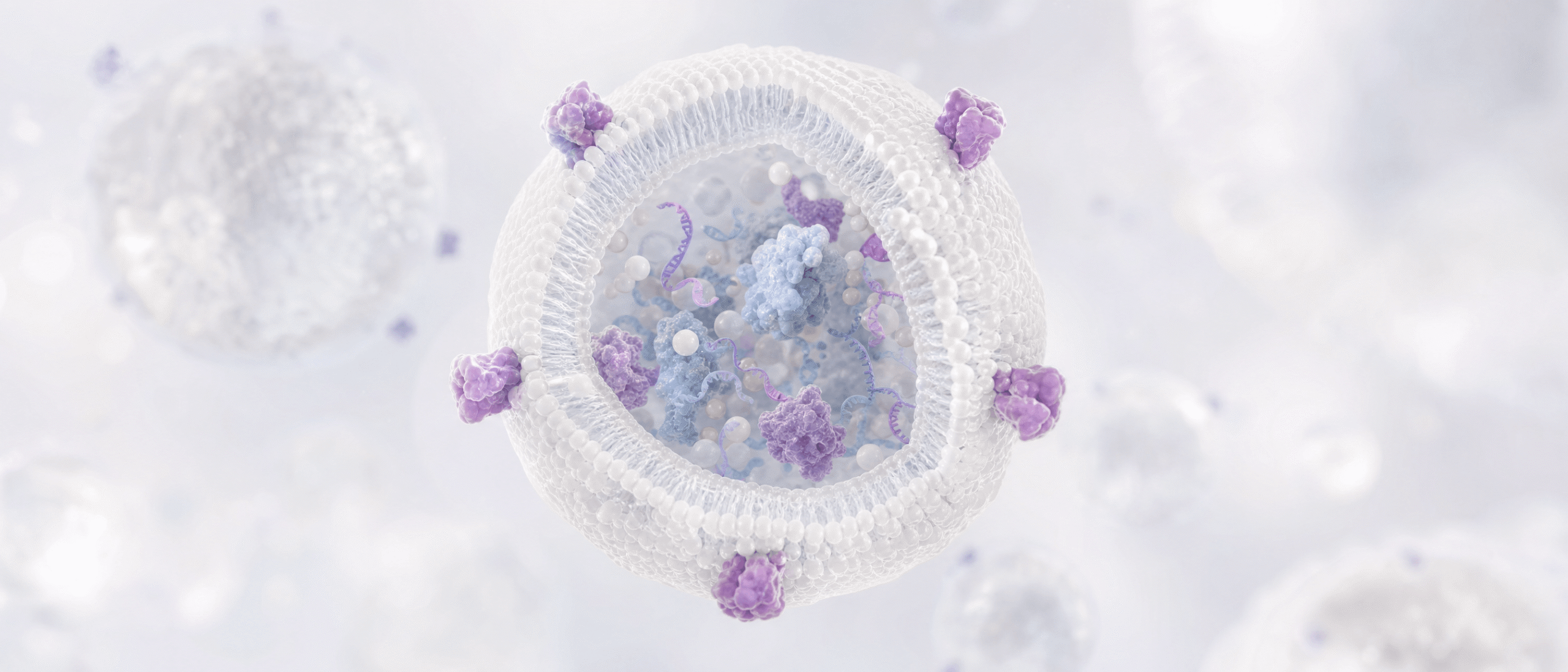
An exosome is a nanoscale, lipid-bilayer vesicle: a membrane-enclosed structure released by a cell via the endosomal pathway. It is not a living cell, and not a fragment of one. What makes an exosome distinct from the other four categories on this list is its cargo. A single vesicle can carry proteins, lipids, and nucleic acids together, packaged as a unit for paracrine signaling between cells (Zhang et al., 2019). That combination of membrane plus mixed cargo is what separates an exosome from a growth factor, which is a single protein with no membrane at all, and from a secretome, which describes an entire secreted profile rather than one vesicle type within it.
Because exosomes are cell-free, sourcing and handling considerations center on the originating cell population, the isolation method, and cargo consistency between lots. That’s a different due-diligence profile than a live-cell product requires. For a full walkthrough of exosome biogenesis, isolation, and cargo composition, see CellGenic’s [exosomes pillar page](URL-TBD: exosomes-pillar-what-are-exosomes).
Growth Factors: Individual Signaling Proteins
A growth factor is a single protein species that binds a specific cell-surface receptor to influence processes like cell proliferation, migration, or differentiation. Familiar names like PDGF, VEGF, TGF-β, and EGF each refer to one defined protein, not a mixed population of biological material. That single-molecule structure is the key distinction from an exosome or a secretome: a growth factor has no membrane, carries no separate cargo, and functions as one signaling input rather than a packaged set of several.
Growth factors reach a supplier’s catalog through one of two routes: recombinant production, where the protein is manufactured directly, or isolation from a biological source. Platelet-rich plasma (PRP) is the most familiar example of the second route: a concentrate of the growth factors released from platelet alpha-granules in whole blood. PRP is a growth-factor-based product, distinct from a vesicle-based or whole-cell product, which is exactly the distinction CellGenic’s [Exosomes vs. PRP vs. Mesenchymal Stem Cells: A Provider Comparison](URL-TBD: exosomes-vs-prp-vs-stem-cells) works through in more depth.
Secretome: The Umbrella Term, Not a Single Compound
“Secretome” is where most of the terminology confusion in this list originates. The word itself is a category description, not a compound. The secretome is the complete set of molecules a given cell or tissue secretes into its surrounding environment, which includes soluble factors (growth factors, cytokines, chemokines) and extracellular vesicles (exosomes) together, as one combined output.
That’s the real source of the ambiguity. Some suppliers use “secretome” to mean the full conditioned media, vesicles and soluble factors both, while others use the same word to mean only the vesicle-free, soluble fraction left after exosomes have been removed. Those are two different products described with one word. A provider evaluating a “secretome” listing should ask specifically which fraction is being supplied. “Secretome” alone doesn’t answer that question. It names the category, not the composition.
PDRN: A Nucleotide-Based Compound, Not a Protein
PDRN, or polydeoxyribonucleotide, is structurally unrelated to every other category on this list. It’s a mixture of deoxyribonucleotide fragments, typically ranging from roughly 50 to 1,500 kDa in molecular weight, derived from the purified, fractionated DNA of salmonid gonadal tissue (commercial material is predominantly salmon or trout sperm-derived; PDRN was historically also isolated from human placenta). That composition, genetic material rather than a protein or a lipid vesicle, is what distinguishes it from a growth factor (a protein), an exosome (a vesicle), and a peptide (an amino-acid chain).
Mechanistically, PDRN’s primary documented activity runs through the adenosine A2A receptor: activation increases intracellular cAMP, with downstream associations to VEGF expression, fibroblast activity, and modulation of inflammatory cytokines including TNF-α and IL-6 in published research. Regulatory status matters here. PDRN carries registered pharmaceutical status in certain jurisdictions internationally, including formal approval by Italy’s medicines authority in 1994 for tissue repair and wound healing (a peer-reviewed review of PDRN’s mechanism and regulatory history). That approval status elsewhere doesn’t extend to CellGenic’s own supply. PDRN sourced through CellGenic is provided strictly for research use, under the same provider-verification model that governs the rest of the catalog.
Peptides: A Separate Category Entirely
A peptide is a short chain of amino acids, shorter than a full protein by definition, and chemically unrelated to a vesicle, a secreted-factor profile, or a nucleotide polymer. That’s the entire category distinction that matters here: peptides sit apart structurally from exosomes, growth factors, secretome material, and PDRN, and shouldn’t be grouped with any of them on the basis of shared “regenerative” marketing language.
CellGenic’s peptide catalog spans multiple named research compounds, each with its own mechanism and evidence base, and that level of detail sits outside the scope of a category-definition piece like this one. All peptide material referenced on this site, including in this article, is supplied strictly for research use only.
Why the Terms Get Blurred
The confusion isn’t accidental. All five categories get marketed under the same “regenerative medicine” umbrella, and several are sourced from overlapping biological starting material, cultured cells in particular. “Exosome,” “secretome,” and “growth factor” in particular describe things that can legitimately co-occur in the same conditioned media, which makes it easy for supplier copy to treat them as one product with three names. A conditioned-media product can contain exosomes and soluble growth factors at once, but that doesn’t make the two terms synonymous. The product simply spans two categories that need to be itemized separately, not merged into one.
For a clinic or research buyer, the practical takeaway is straightforward. Ask which specific category, or categories if more than one is present, a given product actually falls into, rather than accepting a supplier’s chosen umbrella term at face value. CellGenic’s [skincare-protocol sourcing guide](URL-TBD: exosomes-skincare-pillar) walks through how this category confusion plays out specifically in aesthetic-protocol sourcing, where all five terms surface most often in provider inquiries.
Common Questions
Not necessarily. Secretome is a broader category that can include exosomes, soluble factors, or both together. A product labeled "secretome" without specifying which fraction it contains hasn't actually told you its composition.
No. PDRN is a nucleotide-based compound, fragments of DNA, while a peptide is a chain of amino acids. They're chemically distinct classes of molecule that happen to appear in adjacent marketing categories.
PRP is one common source of growth factors, not the category itself. PRP is a platelet concentrate, and the growth factors it contains are released from platelet alpha-granules. A recombinant growth factor product contains the same class of molecule with no platelet or plasma component at all.
Not identically. CellGenic supplies every category under the same research-use framework, but the underlying regulatory picture differs by category and jurisdiction. PDRN, for example, holds registered pharmaceutical status in some countries for indications outside CellGenic's research-use model, which the other four categories don't carry in the same way.
Overlapping biological source material and a shared "regenerative medicine" marketing umbrella make it easy to blur the categories in copy, even when the underlying products are structurally distinct. Precision in terminology is a reasonable thing to expect from a supplier working across multiple categories.
REGULATORY DISCLAIMER · EXOSOMES
These products are intended for laboratory research use only. They are not drugs, foods, cosmetics, or medical treatments and must not be used for any form of human or animal administration. All information provided is for educational and scientific reference only and the products should be handled exclusively by licensed, qualified professionals. Misbranding, misuse, or mislabeling of these products as therapeutic or consumable substances is strictly prohibited by law.