 Medically Reviewed By
— Written By
— Updated on September 16, 2026
The fast fact
On this page

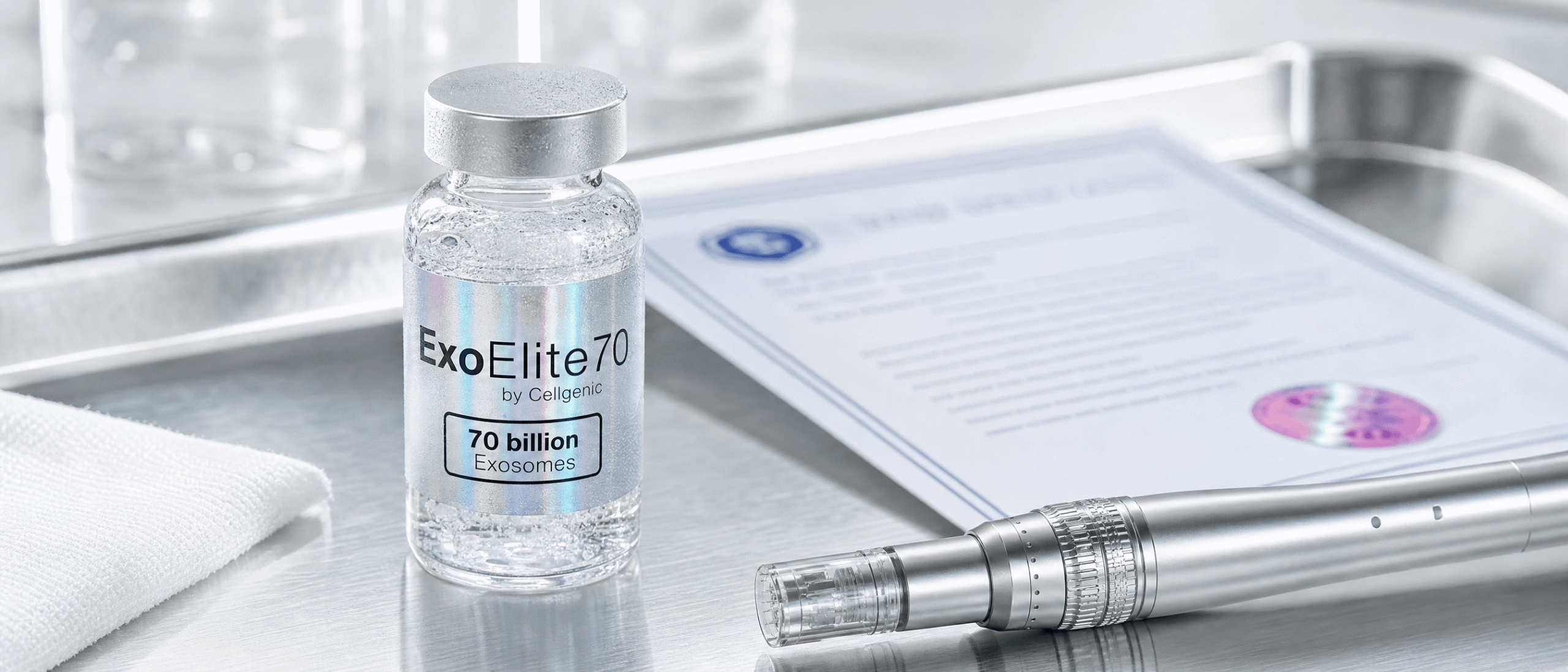
How much exosomes cost depends on far more than the number printed next to a vial. Two products may both be marketed as exosomes while differing in particle concentration, source material, isolation method, characterization, batch testing, and storage or shipping requirements. Those differences can make a direct price-per-vial comparison misleading.
For physicians, researchers, clinics, and distributors, the more useful question is not simply “How much does an exosome vial cost?” It is “What am I actually getting for that price, and how does the cost translate into the requirements of my research protocol?” A lower-priced vial may contain a different particle concentration or come with less extensive batch documentation, while a higher-priced product may reflect additional characterization, quality-control testing, manufacturing, or cold-chain requirements.
CellGenic’s current pricing is available through provider verification rather than as a single public price. This reflects differences in order volume, region, and account type, rather than a single price applying to every buyer. Understanding the factors behind exosome pricing can therefore be more useful than relying on a headline figure alone.
This guide breaks down the main factors that influence exosome vial cost from particle concentration and source material to characterization, manufacturing scale, and logistics and explains how to compare products using information that goes beyond the sticker price
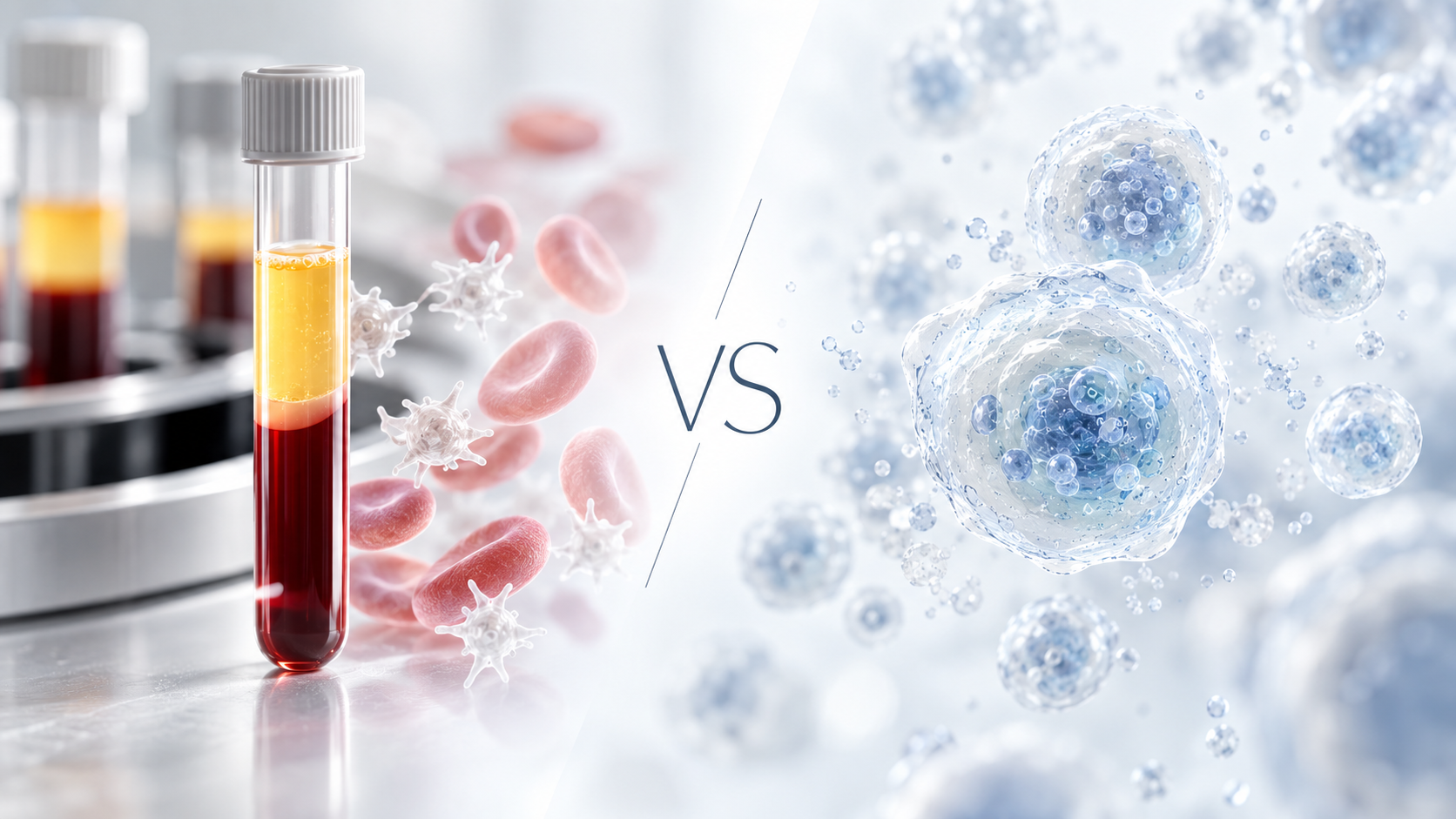
Why the Same Word Can Describe Very Different Products

Particle Count, and How It's Actually Measured
The single biggest driver of per-vial cost is particle count, the number of vesicles packed into that specific volume. This gets measured by nanoparticle tracking analysis or a comparable method, which tracks individual particles in a fluid sample and estimates concentration from their movement. Two vials of identical volume can carry very different particle counts depending on how concentrated the starting isolate was and how much dilution happened downstream. Particle count is one of the few numbers on a spec sheet that’s genuinely comparable across suppliers, provided both are actually testing and reporting it the same way. [1][6]
Price comparisons go wrong at exactly this point. A vial priced lower per unit but carrying a fraction of the particle count of a higher-priced competitor looks cheap on the sticker and expensive once you normalize to particles per dollar. Reputable suppliers publish particle concentration on the Certificate of Analysis for the specific batch, not as a general product-line claim. That’s the detail that actually lets a buyer compare honestly. [1][6][7] [VERIFY: current vial sizes/particle counts]
Testing methodology matters as much as the result. Nanoparticle tracking analysis has known variability between instruments and operators, so a particle count from an uncalibrated or poorly maintained system can overstate concentration in ways that look strong on a spec sheet and don’t hold up under independent verification.

Source Tissue and Cell Line
Raw material cost varies by source, and source varies more than most buyers expect. Mesenchymal stem cell lines from bone marrow, adipose tissue, and umbilical cord each require different collection, screening, and expansion protocols before they ever reach the bioreactor stage, and umbilical cord sourcing in particular carries its own donor-screening and tissue-banking overhead. Induced pluripotent stem cell lines involve a different cost structure again, built around reprogramming and quality-control steps that bone-marrow or adipose sourcing doesn’t need. Plant-derived material sidesteps animal and human tissue handling entirely, which changes the cost profile in the opposite direction.
Whether one source is categorically better than another for a given research application is a separate question this article won’t settle. What matters here is that the raw material going into a vial carries its own cost history before a single characterization test gets run, a history that shows up in the final price whether or not a supplier explains it.

Depth of Characterization and Testing
Testing is where a supplier’s actual costs, and a buyer’s actual assurance, live or die. MISEV2023, the extracellular vesicle field’s current characterization standard, recommends confirming a preparation across several independent categories: particle size and concentration, positive protein markers, negative markers that flag contamination, and morphological confirmation by electron microscopy (Welsh et al., Journal of Extracellular Vesicles, 2024). Running all of that, on every batch, with results tied to a specific lot number rather than asserted at the product-line level, costs meaningfully more than running a subset of it or none at all. [1][2]
This is the least visible cost driver and arguably the most important one. A Certificate of Analysis that names a specific marker panel, a specific isolation method, and batch-specific sterility, mycoplasma, identity, and potency results represents real laboratory work behind every line item. A COA that asserts purity and identity in general terms, without naming what was actually tested, may reflect a genuinely lower-cost product, or it may reflect a product where testing simply didn’t happen. A buyer can’t always tell the difference by price alone, which is exactly why the documentation matters more than the number on the invoice. [1][3]
Cold Chain, Batch Size, and Manufacturing Scale
Logistics and manufacturing scale add their own layer of cost that has nothing to do with what’s biologically inside the vial. Cold-chain shipping, whether a product travels frozen or lyophilized, and how much temperature-excursion monitoring accompanies that shipment, adds real cost that scales with distance and regulatory complexity, particularly for cross-border shipments into Mexico, Argentina, Colombia, and Perú, where import and customs handling differ by market.
Batch size cuts in the opposite direction from what buyers often assume. Small-batch production usually costs more per unit, not less, because fixed costs, facility time, quality-control runs, equipment setup, get spread across fewer units. Large-scale GMP manufacturing can achieve lower per-unit costs, but only once batch-to-batch consistency has actually been solved at that volume, which remains a live challenge across the field rather than a settled one. A supplier offering a large discount for a very large batch size should be able to explain how consistency holds up at that scale, not just that the price drops.
For distributors evaluating volume purchasing specifically, this is the section worth reading twice. The per-unit economics of scale only work in your favor if the underlying batch consistency scales with it. A lower blended cost across a large order isn’t worth much if a meaningful share of that order fails quality checks on arrival.
Cost-Per-Vial vs. Cost-Per-Protocol: The Number That Actually Matters
Every driver above rolls up into a single practical question: what does it actually cost to complete a given research protocol, not what does one vial cost in isolation. These are genuinely different numbers, and conflating them is the most common way a price comparison goes wrong. [6][7]
A lower-priced vial with a lower particle count may require more vials to reach the same total particle exposure a protocol calls for, which can push the total cost of the protocol above a more expensive vial with a higher concentration, even when the per-vial sticker price suggested the opposite. The only way to compare honestly is to normalize everything to the same unit: cost per billion particles, or cost per protocol at a defined particle target, rather than cost per vial at an unspecified concentration.
Source, testing depth, and batch consistency all compound here rather than sitting side by side as separate line items. A protocol built around inconsistent batches doesn’t just risk variability from one order to the next. It risks needing to reorder, re-verify, or adjust a protocol mid-course, and each of those carries its own real cost in clinic time and administrative overhead, on top of whatever the vials themselves cost. Nothing above claims anything about what a particular product will or won’t accomplish clinically. The point here is purely arithmetic: plan against the protocol total, not the vial price in isolation.

Why the Cheapest Vial Is Often the Most Expensive One in Practice
Put the drivers above together, and a pattern emerges. A vial priced well below the rest of the market is usually cutting cost somewhere: a less rigorous characterization panel, an unverified particle count, a smaller or less consistent batch, or logistics that skip real cold-chain monitoring. Any of those can be a reasonable trade-off depending on what a specific protocol requires. None of them are visible from a price tag alone.
The real cost of an under-documented product tends to show up later: in reorders, in batch-to-batch inconsistency that complicates protocol planning, or in time spent chasing down a Certificate of Analysis that should have been available up front. Comparing suppliers on sticker price alone often means comparing a fully documented product against a partially documented one and treating the difference as savings, when it’s really a documentation gap the buyer inherits.
Where to Go From Here
For a structured checklist on vetting a supplier beyond price, see our guide to what to consider when buying an exosome product, which covers documentation, verification, and sourcing questions in more depth than fits here.
Licensed physicians, clinic owners, and researchers can apply for provider access to review CellGenic’s current vial specifications, batch documentation, and pricing directly.
Common questions
Pricing sits behind provider verification because rates vary by volume, region, and account status, the same way wholesale B2B pricing works across most research-supply categories. A flat public number would misrepresent what most verified buyers actually pay. Apply for provider access to see current, account-specific pricing. [1][6]
Particle count, the number of vesicles packed into a given volume, along with how that count was measured and verified. It's one of the more direct, comparable figures across suppliers, provided both are testing and reporting it consistently.
Not automatically. Price reflects several compounding factors, including source tissue, testing depth, batch size, and logistics, and a higher number doesn't guarantee all of them were handled rigorously. What actually confirms quality is the documentation, not the price tag. [1][3]
Normalize everything to the same unit, cost per billion particles or cost per protocol at a defined target, rather than comparing raw per-vial or per-case pricing. Batch-to-batch consistency at volume matters as much as the blended unit price.
Structure varies by account type and volume, consistent with standard B2B wholesale practice. Specific terms are available once provider verification is complete.
Request the particle count and testing panel for the specific batch you'd receive, not a general product-line claim, along with the isolation method and cold-chain handling details. A supplier who can answer all four quickly is usually pricing accurately, not just competitively.
References
- Welsh JA, Goberdhan DCI, O’Driscoll L, et al. Minimal Information for Studies of Extracellular Vesicles 2023 (MISEV2023): From Basic to Advanced Approaches. Journal of Extracellular Vesicles. 2024;13(2):e12404. doi:10.1002/jev2.12404. Full textpmc.ncbi.nlm.nih
- Théry C, Witwer KW, Aikawa E, et al. Minimal Information for Studies of Extracellular Vesicles 2018 (MISEV2018): Position Statement of the International Society for Extracellular Vesicles and Update of MISEV2014.Journal of Extracellular Vesicles. 2018;7(1):1535750. doi:10.1080/20013078.2018.1535750. PMC
- Gardiner C, Vizio D, Sahoo S, et al. Techniques Used for the Isolation and Characterization of Extracellular Vesicles: Results of a Worldwide Survey. Journal of Extracellular Vesicles. 2016;5:32945. doi:10.3402/jev.v5.32945.
- Théry C, Amigorena S, Raposo G, Clayton A. Isolation and Characterization of Exosomes from Cell Culture Supernatants and Biological Fluids. Current Protocols in Cell Biology. 2006;30:3.22.1–3.22.29. doi:10.1002/0471143030.cb0322s30.
- Vestad B, Llorente A, Neurauter A, et al. Size and Concentration Analyses of Extracellular Vesicles by Nanoparticle Tracking Analysis: A Variation Study Between Different Occasions and Operators. Journal of Extracellular Vesicles. 2017;6(1):1344087. doi:10.1080/20013078.2017.1344087.
- Vogel R, Coumans FAW, Maltesen RG, et al. A Standardized Method to Determine the Concentration of Extracellular Vesicles Using Tunable Resistive Pulse Sensing. Journal of Extracellular Vesicles. 2016;5:31242. doi:10.3402/jev.v5.31242.
- Simons M, Raposo G. Exosomes—Vesicular Carriers for Intercellular Communication. Current Opinion in Cell Biology. 2009;21(4):575–581. doi:10.1016/j.ceb.2009.03.007.
- Kalluri R, LeBleu VS. The Biology, Function, and Biomedical Applications of Exosomes. Science. 2020;367(6478):eaau6977. doi:10.1126/science.aau6977.
- Théry C, Witwer KW, Aikawa E, et al. Minimal Information for Studies of Extracellular Vesicles 2018 (MISEV2018): Position Statement of the International Society for Extracellular Vesicles and Update of MISEV2014. Journal of Extracellular Vesicles. 2018;7(1):1535750. doi:10.1080/20013078.2018.1535750. Full text – PMC
REGULATORY DISCLAIMER · CELLS
These products are intended for laboratory research use only. They are not drugs, foods, cosmetics, or medical treatments and must not be used for any form of human or animal administration. All information provided is for educational and scientific reference only and the products should be handled exclusively by licensed, qualified professionals. Misbranding, misuse, or mislabeling of these products as therapeutic or consumable substances is strictly prohibited by law.